Increase your ROAS and conversions by adding these simple changes to your product listing images. 7 years of A/B tests in one e-book. Get expert tips to optimize your listing and boost your sales - all in our FREE e-book!
Your Profit Is Leaking: What Amazon Brands Miss — and When TikTok Shop Is Actually Worth It
A healthy ACOS can hide a leaking Amazon account. Here's what actually drives profit — and how to know if TikTok Shop is worth adding.
Mark Daniel Zalomajev
Founder
A clean ACOS dashboard feels like proof that everything is working. It usually isn't. You can run a campaign at a great ACOS and still be losing money on stockouts, a stalled organic rank, or a second-year cash crunch nobody budgeted for — the same pattern Zeeshan, who has spent 12 years running an Amazon agency managing more than 900 brands while also owning three of his own, has watched play out across hundreds of accounts.
As an Amazon agency ourselves, that pattern is exactly what we see when a brand comes to us convinced their ads are the problem, when the real leak is somewhere ACOS was never built to look.
ACOS Is the Wrong Dashboard to Stare At
ACOS tells you what one campaign cost. It doesn't tell you whether the business is actually growing. Asked for the one number every brand should watch besides ACOS
New to brand. How many new clients or buyers they got."—Zeeshan Riaz, Urtasker
New-to-brand buyers are the closest thing Amazon gives you to a real growth signal — proof you're pulling in people who didn't already know you, rather than just re-selling to the same shrinking pool at a rising cost. It's the same reason we push clients past ACOS and into blended metrics during Amazon PPC reviews: a campaign can look efficient in isolation while total advertising spend as a share of revenue quietly climbs, which is the leak a single-campaign ACOS number will never surface.
There's also a myth baked into how most brands think about Amazon PPC spend in the first place. Asked for the biggest myth about Amazon advertising, Zeeshan didn't sugarcoat it: advertising isn't cheap, and brands that treat it as a background cost rather than a managed investment usually launch straight into the trap he sees most often — heavy campaigns before the product is ready to convert.
"You spend a lot of money just to explore. That's not how it works."
That's the first leak most brands never label as one: they weren't burned by expensive ads, they were burned by spending on ads before the listing and audience were dialed in enough to make that spend worth anything.
The Leak Nobody Puts in a Report: Inventory Velocity
Before any of that matters, you need stock. Asked for his top Prime Day tip, Zeeshan's answer applies year-round:
Stay hydrated first of all—means stay in stock before you play advertising."—Zeeshan Riaz, Urtasker
A stockout during a demand spike doesn't just cost sales that day — it resets your inventory velocity, drops your rank, and forces you to rebuild organic position you'd already earned. Brands watch ACOS closely and inventory loosely, when inventory is the variable that actually decides whether ad spend has anything to sell against. It's why Amazon account management that only touches advertising misses half the profit picture; PPC and inventory planning have to sit inside the same review, pulling from the same sales-velocity data by SKU and time zone, not two separate spreadsheets that never talk to each other.
Why Year Two Is Where Brands Actually Fail
Most brands don't die at launch. They die in year two, once the launch budget is gone and the account has to run on its own economics. Zeeshan's list of what breaks reads like a profit-leak inventory: chasing a saturated trending category, front-loading ad spend before the listing converts, no cash reserved for a second or third purchase order, no market intelligence on how competitors actually built their volume, no plan for the first wave of negative reviews, and — the one he was most direct about — hiring the wrong ad partner.
Every one of those is a structural problem, not a tactical one. A brand can fix a single campaign in an afternoon; it can't fix cash-flow planning or category selection with a bid adjustment. That's the gap real Amazon account management is supposed to close — treating advertising, inventory, and organic rank as one connected system instead of three separate fires.
Organic Rank Is Built by Conversion, Not Just Traffic
Traffic without conversion just burns budget faster. Fixing the listing's messaging — who the buyer actually is and what they need to hear before they buy — is what turns paid traffic into sustained organic rank, rather than a rank that collapses the moment ad spend pauses. That's the difference between renting a position on page one and owning it.
When TikTok Shop Actually Earns a Second Channel
None of this means TikTok Shop is a distraction. It means the decision to add it needs the same discipline as fixing Amazon itself — because the two channels don't behave the same way, and treating them as interchangeable is its own leak.
Zeeshan was direct about who gets left behind:
The brands who are not addressing that Gen Z audience are losing money."—Zeeshan Riaz, Urtasker
He started on TikTok Shop in its first month in the US, specifically because Amazon's buyer and TikTok's buyer are different people:
It's actually a bigger funnel, it's not the bottleneck. You attract the audience."—Zeeshan Riaz, Urtasker
Gen Z buyers scroll TikTok to explore, not to complete a considered purchase the way they do on Amazon. Zeeshan's own test made the pattern concrete: he emailed 20 past TikTok Shop buyers eight months later and asked if anything had gone wrong.
Most had simply repurchased the same product on Amazon once they trusted the brand — proof that TikTok Shop's real value, done right, is discovery and demonstration, with Amazon still closing the sale. That's a genuine case for multi-marketplace expansion — but only once the Amazon account underneath it is solid enough to catch the traffic TikTok sends its way.
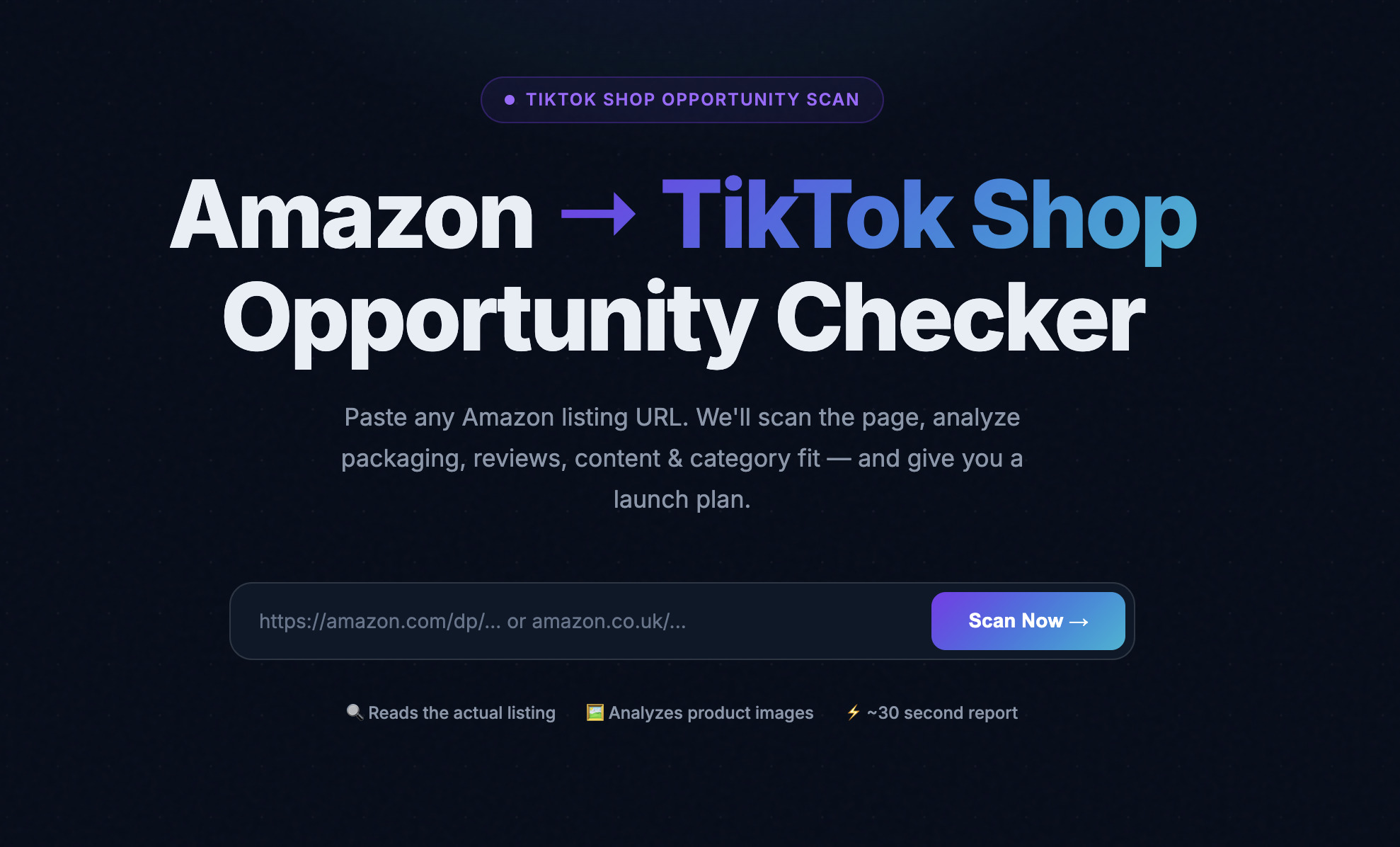
The TikTok Shop Opportunity Checker
This is exactly the gap we built the TikTok Shop Opportunity Checker to close. Most Amazon sellers weighing a second channel don't panic-buy because TikTok Shop is a bad idea — they panic-buy because they skip the operational gates that decide whether it's a good idea for them, right now.
What it is: a free fit-and-readiness check for Amazon sellers considering TikTok Shop as a second channel.
Who it's for: any Amazon brand deciding whether to expand rather than just reacting to headlines about how fast TikTok Shop is growing.
Why it matters: most brands never check the gates that actually determine feasibility before spending on it — a US or UK entity and responsible person, per-country EU registrations if selling into Europe, whether the product category genuinely fits TikTok's demonstration-first format, and whether fulfilment can support a second channel without starving Amazon's inventory velocity.
How to use it: enter your product and target markets, and it returns an opportunity read plus an operational checklist — what's already in place, what's missing, and what to fix before launch rather than after.
ACOS only measures the cost of a single campaign against the sales it generated directly. It doesn't account for stockouts, declining new-to-brand growth, or organic rank that's propped up by ad spend rather than earned through conversion — all of which drain profit without ever showing up in the ACOS number.
Inventory velocity is how quickly stock moves relative to demand. A stockout during a sales spike doesn't just lose that day's revenue — it can drop organic rank and force a brand to rebuild position it had already earned, making future advertising less efficient.
ACOS measures ad spend against ad-driven sales alone. TACOS (Total Advertising Cost of Sales) measures ad spend against total sales, including organic. A declining TACOS over time signals organic rank is genuinely growing, not just being rented through advertising.
Common causes include chasing an already-saturated trending category, overspending on ads before the listing converts, running out of cash for a second or third purchase order, lacking market intelligence on competitors, and hiring underqualified advertising partners.
For many brands, TikTok Shop functions as a discovery funnel rather than a direct sales channel. Buyers see a product demonstrated on TikTok, then search for and purchase it on Amazon once they trust the brand — meaning TikTok Shop and Amazon can reinforce each other rather than compete.
Key gates include having a US or UK entity and responsible person, any required per-country EU registrations, whether the product category fits TikTok's demonstration-led format, and whether fulfilment operations can support a second channel without disrupting Amazon inventory.
The free TikTok Shop Opportunity Checker at check.innels.com/tiktok-checker lets sellers enter their product and target markets to get an opportunity assessment plus an operational readiness checklist before committing budget.
Amazon should generally come first. If advertising, inventory velocity, or organic rank are already underperforming, adding a second channel compounds the problem rather than solving it — TikTok Shop works best as an amplifier for an account that's already structurally sound.




%20(1).png)






















.png)



.jpg)


.jpg)
.jpg)

.jpg)