Increase your ROAS and conversions by adding these simple changes to your product listing images. 7 years of A/B tests in one e-book. Get expert tips to optimize your listing and boost your sales - all in our FREE e-book!
Marketplace Pulse data shows limited overlap between Amazon and TikTok Shop’s top sellers. Here’s what Amazon brands should know before expanding.
Andrey Klimovskij
Co-Founder
In this week’s INNELS Amazon Seller News, we look at new Marketplace Pulse research showing that Amazon’s biggest sellers and TikTok Shop’s biggest sellers are largely different businesses. The data highlights an important point for brands considering TikTok Shop expansion: strong Amazon sales do not automatically translate into success on a content-driven marketplace.
Amazon and TikTok Shop Have Very Different Top Sellers
Marketplace Pulse compared the 10,000 largest sellers on Amazon.com and TikTok Shop in the US and found only 498 businesses appearing on both lists, representing around 5% of either platform’s top 10,000 sellers.
The difference becomes even clearer among the largest businesses. One in five of TikTok Shop’s 100 largest US sellers also ranks among Amazon’s top 10,000 sellers. In the other direction, only one in 25 of Amazon’s 100 largest sellers appears among TikTok Shop’s top 10,000.
Marketplace Pulse says this shows that the two platforms reward very different types of businesses. A seller’s position on Amazon also has almost no relationship with its position on TikTok Shop.
Why Amazon Success Does Not Automatically Transfer
The customer journey is one of the biggest differences. Amazon has spent decades building a purchase-focused environment. Customers often arrive with a product or problem already in mind, search for the relevant products, compare reviews and prices, and complete their purchase through a familiar checkout and fulfillment system.
TikTok works differently. Products can be introduced to customers before they have any intention of buying them. A creator demonstrates something in a video, the viewer becomes interested, and the product can then be purchased directly through TikTok Shop. Marketplace Pulse argues that TikTok is primarily a demand-generation environment, while Amazon remains a major destination for completing purchases. The research points to cases where products discovered through TikTok still generate searches and purchases on Amazon.
Amazon’s Winning Formula Is Different
Amazon sellers typically build their businesses around search visibility, reviews, advertising, conversion rates and inventory availability. Those factors remain important on Amazon, but they do not necessarily create the same advantage on TikTok Shop.
Marketplace Pulse describes TikTok Shop's successful products as those that can be demonstrated effectively on camera, often within a very short video. The seller also needs to treat content as a major part of the business and work with creators who can introduce the product to their audiences.
That creates a fundamental difference in product selection. A replacement charging cable, printer paper or a basic storage product may have strong Amazon demand because customers actively search for these products. But the same product may be difficult to turn into engaging content that stops someone from scrolling.
Product Fit Matters More Than Amazon Sales
This is one of the most important lessons for Amazon brands considering TikTok Shop. A product can have thousands of reviews, strong organic rankings and consistent Amazon sales and still have limited TikTok Shop potential.
The opposite can also happen. A product with a smaller Amazon business can have strong TikTok potential if it is visually interesting, solves an obvious problem or can be demonstrated through a compelling before-and-after, tutorial or creator format. This means brands should not automatically take their Amazon best-seller report and upload the entire catalog to TikTok Shop. The better approach is to identify which products are actually suited to the way TikTok customers discover and evaluate products.
TikTok Shop Is Already Highly Concentrated
There is another challenge for brands entering TikTok Shop. Marketplace Pulse reports that the top 1% of TikTok Shop sellers account for around 60% of sales. This suggests that while it is relatively easy to create content and enter the platform, generating meaningful sales requires more than simply listing a product.
Creator relationships can become an important competitive advantage. Brands need to identify relevant creators, provide products or samples, develop content angles, manage commissions and understand which types of content actually generate conversions. For brands entering the channel now, this means the opportunity is there, but so is an increasingly established competitive environment.
TikTok Shop Can Still Be Valuable for Amazon Brands
The research should not be interpreted as saying Amazon sellers should avoid TikTok Shop. Instead, it shows that brands need to measure the channel differently.
TikTok can introduce a product to customers who were not actively searching for it. Those customers may purchase directly through TikTok Shop, but they may also search for the brand on Amazon after discovering it through content.
Marketplace Pulse argues that for existing Amazon sellers, branded searches on Amazon can therefore be an important metric when evaluating the impact of TikTok activity.
This creates an interesting relationship between the two marketplaces. TikTok can create demand, while Amazon can remain the place where some of that demand converts.
Amazon success and TikTok Shop success are not interchangeable. A product can rank highly on Amazon because customers are actively searching for it, but that does not mean it will capture attention in a TikTok video. Brands need to evaluate product-market fit for each channel instead of assuming that their best Amazon sellers will automatically become their best TikTok Shop products.” — Andrejs Klimovskis, Co-Founder of INNELS
For brands moving from Amazon to TikTok Shop, the first step should not be uploading the entire catalog. It should be identifying the products that can win attention in a short video and then building a content and creator strategy around them.
The Question Amazon Brands Should Ask
Instead of asking, “Which of our products sells the most on Amazon?”, brands should ask, “Which of our products can create demand through content?” That changes the evaluation process.
A strong TikTok Shop candidate may have visual appeal, a clear problem-solution story, an obvious demonstration, strong customer reviews that can provide content ideas, or a product experience that creators can easily show to their audiences. Amazon sales are still useful evidence. But they should be treated as one input rather than proof that the product will work on TikTok Shop.
Check Your Products Before Expanding to TikTok Shop
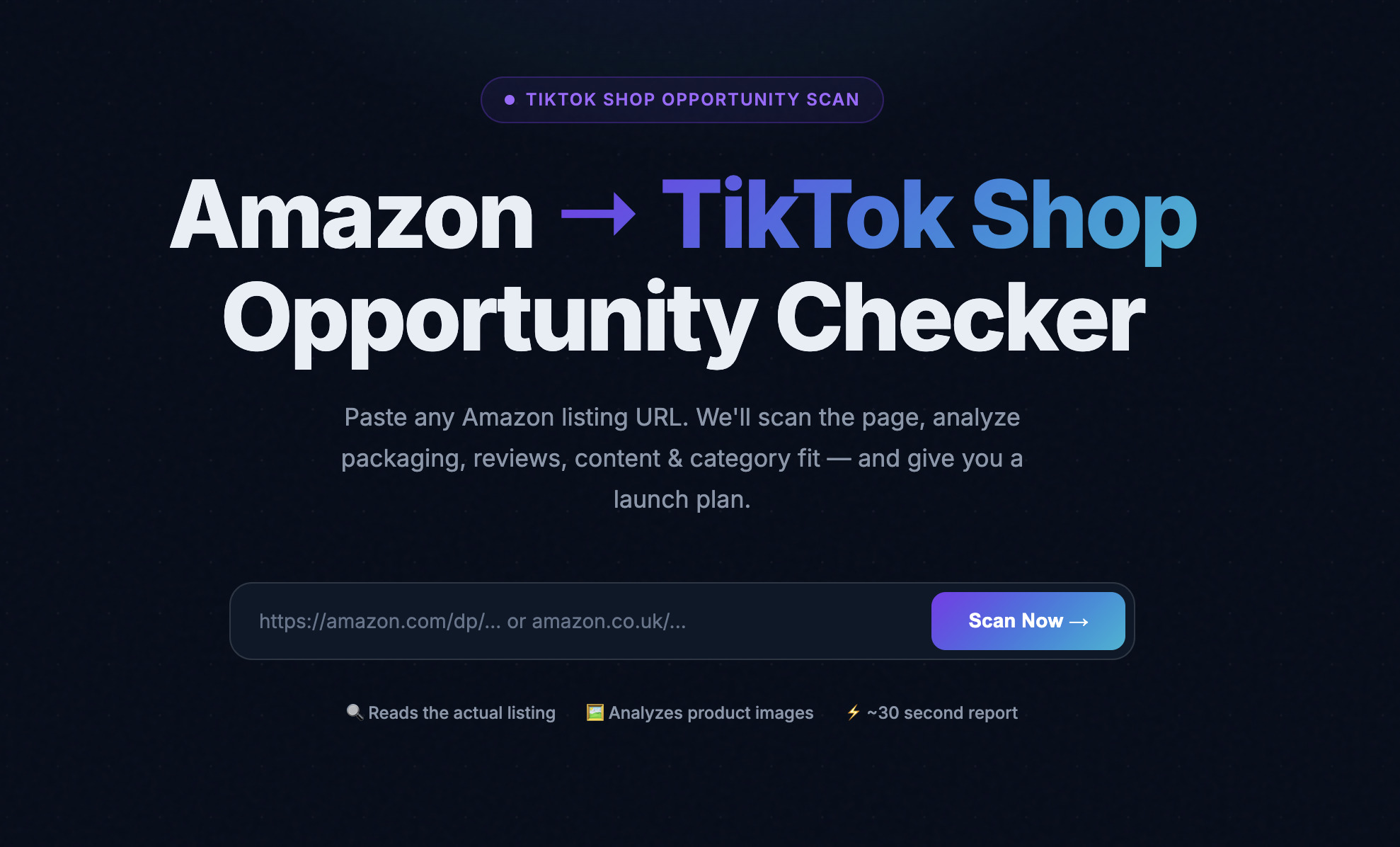
This is exactly where product-level analysis can help. INNELS has developed the TikTok Shop Opportunity Checker to help Amazon brands assess whether their products have potential for TikTok Shop before investing heavily in the channel.
The tool analyzes an Amazon product and evaluates factors such as packaging and visual appeal, review strength, content quality and TikTok Shop category fit. It then provides a readiness score and a five-step launch plan.
Moving from Amazon to TikTok Shop is not simply a marketplace expansion exercise. On Amazon, brands can invest heavily in improving search visibility, PPC, listings and conversion. On TikTok, the product needs to earn attention first.
That means creative testing, creator partnerships and content production become much more important. Brands also need to understand which products can generate repeatable content rather than relying on one viral video.
The strongest strategy may therefore be selective rather than broad: identify the products with the best TikTok potential, test them with different creators and content angles, and scale the products that demonstrate real demand.
Final Perspective
Marketplace Pulse’s research makes one thing clear: Amazon and TikTok Shop are not simply two versions of the same marketplace. Only a small percentage of the largest sellers overlap between the two platforms because the platforms reward different customer journeys, product characteristics and selling strategies.
For Amazon-first brands, that means TikTok Shop should be approached as a new demand-generation channel rather than another place to upload an existing catalog. Your best Amazon seller may not be your best TikTok Shop product. The opportunity is to find out which products can make that transition before spending the budget to build the channel around them.
Not necessarily. Marketplace Pulse found only 498 sellers in both platforms’ top 10,000 lists, representing around 5% of either list.
Only about 5% of the sellers in each platform’s top 10,000 lists appear on both platforms.
Amazon is heavily driven by search, reviews, advertising and purchase intent, while TikTok Shop relies much more on content, discovery and creator-driven demand.
No. A product can perform extremely well on Amazon but have limited potential if it is difficult to demonstrate or make interesting through short-form content.
Products that can be demonstrated, worn, applied, consumed or visually transformed can have a natural fit with TikTok content.
Yes. Customers can discover a product through TikTok and then search for the brand or product on Amazon to complete the purchase.
Creators can demonstrate products, introduce them to relevant audiences and generate sales through creator-led content and commissions.
Not necessarily. Brands should first identify which products have the strongest content and TikTok Shop potential before expanding their full catalog.
Amazon Seller News is a weekly INNELS series covering the latest updates every Amazon seller should know. In 2025, INNELS helped its clients generate more than €11 million in sales, and in 2026, the agency was included in PeekWire’s list of the top five Amazon agencies in Europe.




%20(1).png)























.png)



.jpg)


.jpg)
.jpg)

.jpg)